Prompt Library and Prompt Chains for Claude and ChatGPT
Anyone who uses AI for real work ends up with a handful of prompts they type again and again — a review checklist, a house style, a particular way of framing a research question. Most people keep them in a notes app and paste them across, which means leaving the page, finding the right note, and copying carefully. ChatPeer puts them one keystroke away instead. Save a prompt once, then type // in the composer and pick it from a list that filters as you type; the // is replaced by the prompt body. Prompts are stored per account rather than per site, so the library you build on Claude is the same one you have on ChatGPT — unlike folders, which are deliberately kept separate per platform.
Inserting a prompt with //
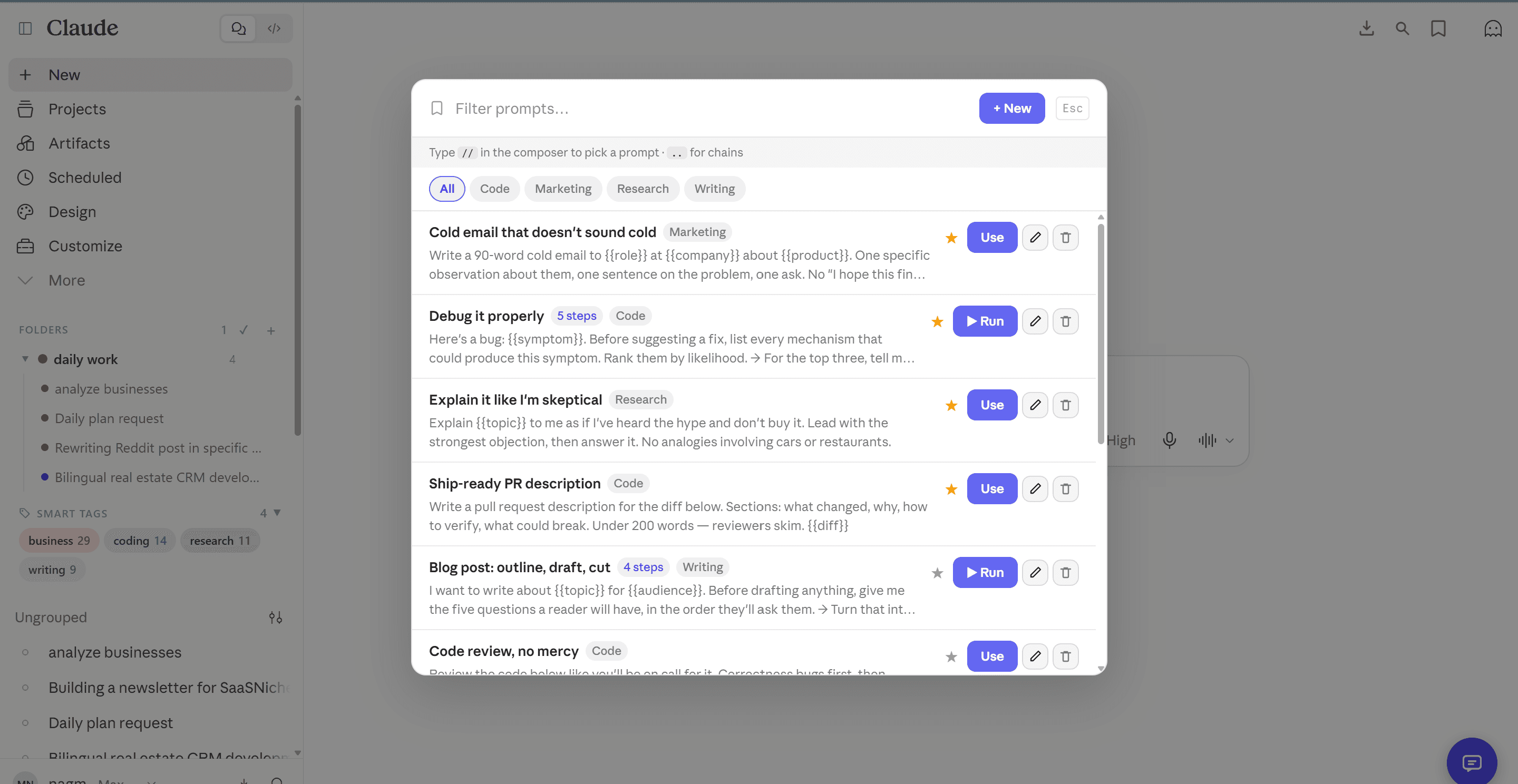
Type two forward slashes anywhere in the composer and a picker appears above the cursor. Keep typing to filter by title or category; arrow keys move through the list, Enter or Tab inserts. The trigger text is replaced by the prompt body, so you can carry straight on typing after it. If nothing matches what you typed, the picker offers to save it as a new prompt there and then.
Categories and favourites
Each prompt can carry a category, and favourites sort to the top of both the picker and the library. Once you pass a dozen prompts that ordering is what keeps the picker usable — the three you reach for daily stay at the top without you having to scroll past the ones you wrote in January.
Prompt chains
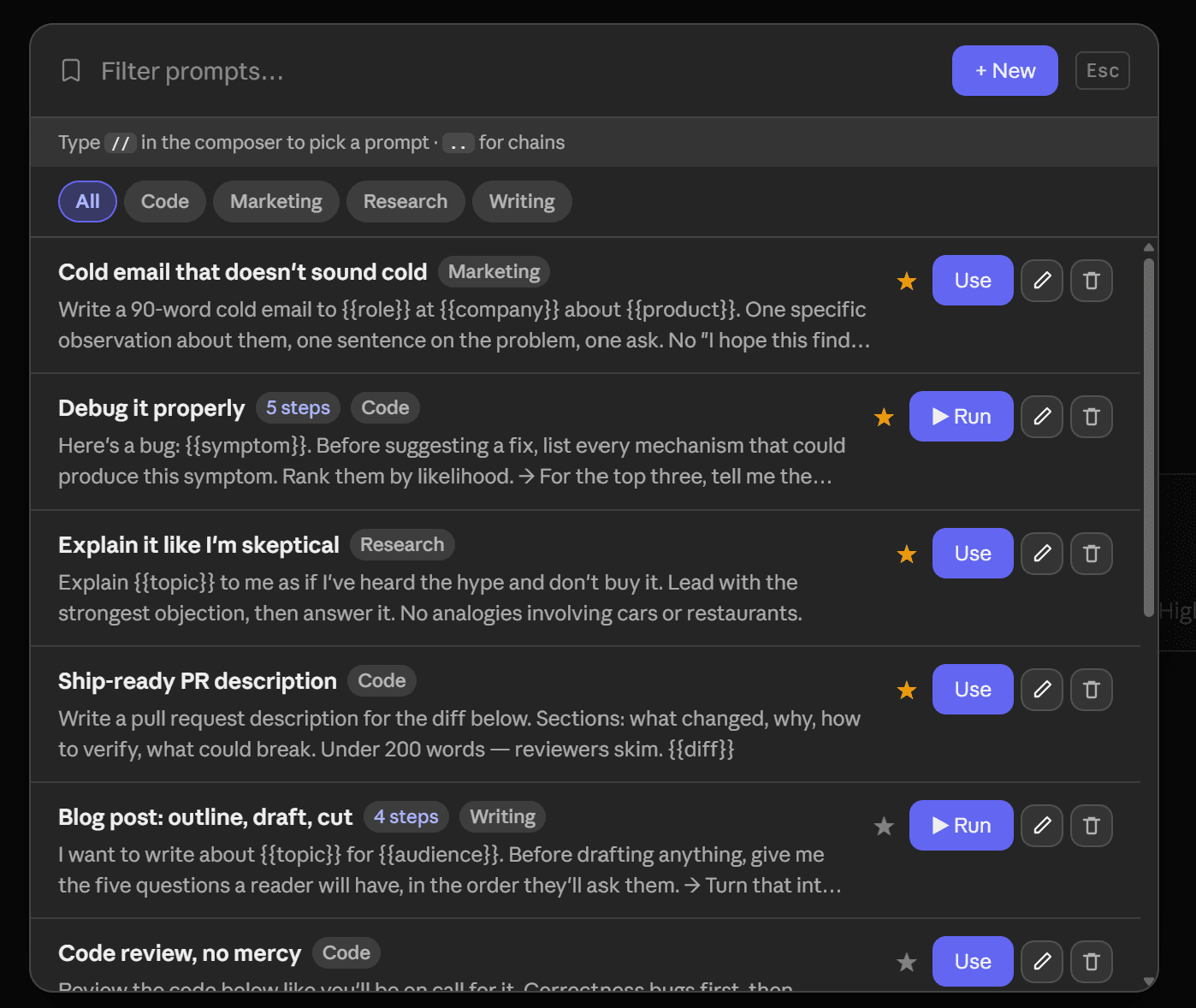
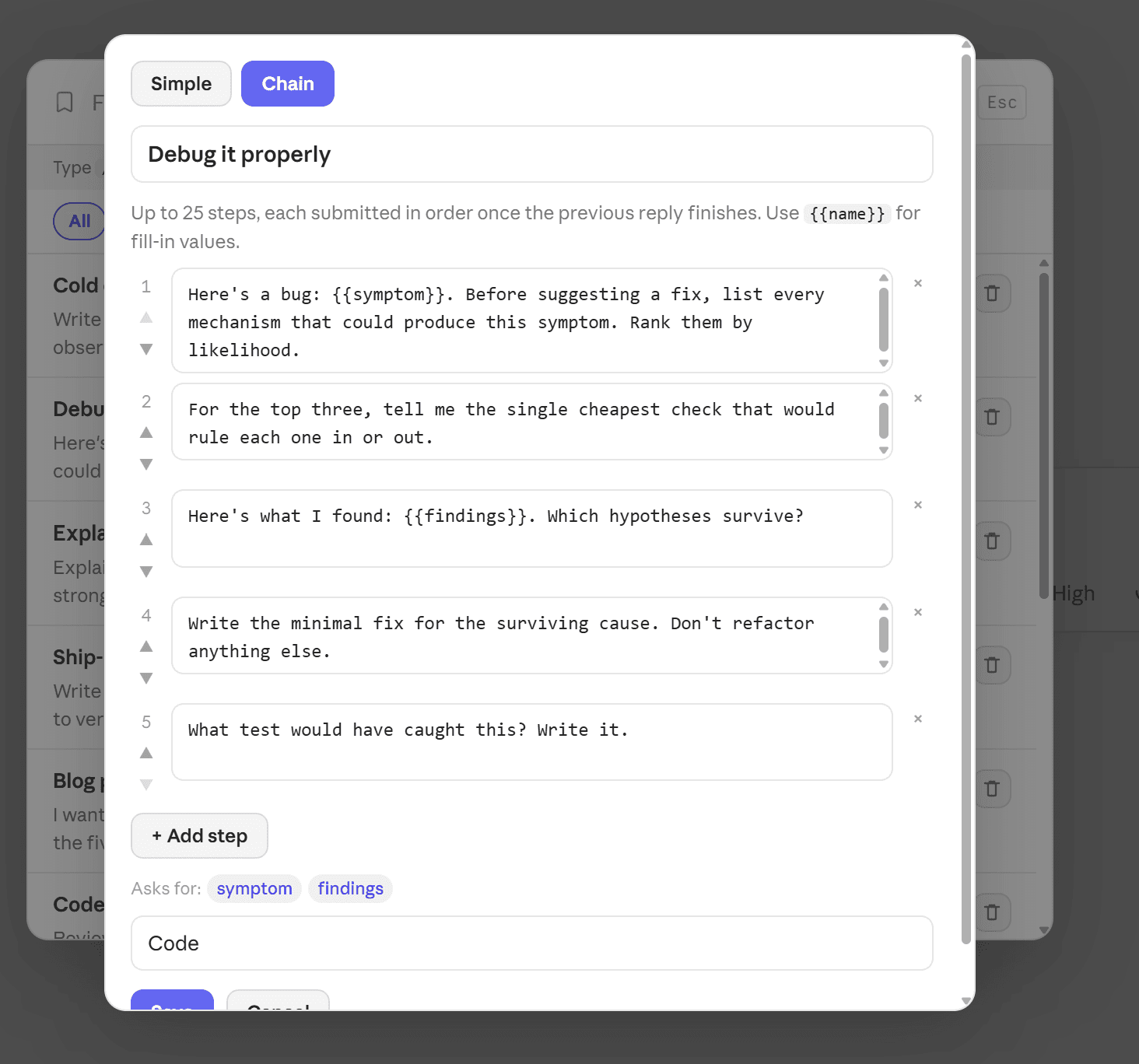
A chain is a prompt with steps instead of a body — up to 25 of them. Trigger one by typing .. in the composer and ChatPeer submits the first step, waits for the assistant to finish responding, then submits the next, and so on. It genuinely waits for streaming to complete rather than firing on a timer, so a long answer doesn't cause the next step to be swallowed. A chain can be stopped mid-run from the indicator that appears while it is working.
Placeholders filled in at run time
Write {{client}} or {{deadline}} anywhere in a chain's steps and ChatPeer asks for those values in a short form before the run starts, substituting them into every step. One chain then covers every client or project rather than needing a copy per variant.
Where to find it
A Prompts button sits under the composer, and the prompt library is also in the floating ChatPeer menu. Free accounts can save 2 prompts; premium accounts have no limit. Chains can be up to 25 steps on every plan, including free.
Questions
- Are my prompts shared between Claude and ChatGPT?
- Yes. Prompts are stored in extension storage rather than per-site storage, so one library serves both platforms. Folders and bookmarks are kept separate per platform, because a folder structure for one rarely makes sense for the other.
- How many steps can a chain have?
- Up to 25, on every plan including free. The step limit isn't a paid feature — the number of prompts you can save is.
- What happens if a chain step fails or I need to stop it?
- A running chain shows an indicator with a Stop button, and stopping it leaves everything already sent in place. Nothing is undone — the conversation simply stops advancing.
- Do prompts sync to your servers?
- No. They're in your browser's extension storage. If you sign into Chrome on another computer, Chrome's own sync may carry them across; ChatPeer never sends them anywhere.
Related features
Your conversations never leave your browser
ChatPeer builds a full-text search index locally inside Chrome's IndexedDB — the same storage that keeps your browser history and bookmarks. Nothing is uploaded to our servers. We store your email address and license key hash. That's it.
Free to install. No account required.
Add to Chrome — it's free